
What Awe Does to a Selfie—And to a Life
Joy. Connection. Less distress. From a practice so simple, you might overlook it.

Imagine you’re walking the same route you always do—same sidewalk cracks, same mailbox leaning like it’s had a day. You’re not trying to think about your to-do list, but there it is: circling like a hawk with a clipboard.
And then, mid-loop, you look up.
A single leaf. Caught in a spiderweb. Spinning in the breeze like it’s doing interpretive dance.
You stop.
You watch.
You forget what was next on the list.
That flicker? That’s awe.
And no, it’s not reserved for Grand Canyons, NASA launches, or northern lights. With the right kind of attention, awe can be found in the way a tree shadow flickers across concrete. In the layers of sound inside a birdcall. In the fact that moss just… grows. For free.
The Quiet Power of Whoa
Awe is what happens when you’re faced with something vast or new—and your brain, usually so chatty, finally lets the moment speak for itself. It can’t quite fit what it sees into its usual boxes—and so, for a breath or two, it stops trying. It’s the feeling of whoa without needing to define why.
But awe doesn’t just lift your gaze. It helps us zoom out of our inner monologue and feel connected to something larger than ourselves. It’s not about you—and that’s the whole point.
In that shift, something beautiful unfolds.
Studies show awe helps our worries shrink, our perspective widen, and our sense of self-importance loosen its grip. We feel smaller—but not lesser. Just more connected. To nature. To strangers. To something larger and shared.
And that shift in attention? It doesn’t just tug at your heartstrings. It tunes you into the whole orchestra.
When people feel awe, they tend to act more generously. They experience more empathy, more well-being, more humility. It’s like awe opens a little window, and through it, we remember that we’re part of a bigger story—and that the other characters matter too.
Which might be why awe doesn’t just make us feel good. It makes us good for each other.
And the best part?
You don’t need to summit a mountain or visit the Taj Mahal. Awe is less about where you look—and more about how you look.
So what happens if you start building awe into your routine?
They Walked With Awe. Here’s What Changed.
At UCSF, researchers ran a study with older adults—many in their 70s. The task? Simple: take a 15-minute outdoor walk, once a week, for eight weeks.
But here’s the twist:
One group just walked.
The other got special instructions—
Try to walk outside with awe.
Tap into your childlike sense of wonder.
Look for newness.
Phones down, eyes open. (Airplane mode was encouraged. Photos were the one exception—because obviously, if a squirrel strikes a pose, you document it.)
Keep the pace light to moderate—not a workout, more of a wander.
That’s it.
And the results? Let’s just say: awe walks the walk.
Compared to the control group, who just... walked, the awe walkers experienced something different:
More awe, joy, appreciation, admiration, and compassion during their walks.
Outside of the walks they felt it too. They reported more daily moments of prosocial emotion—like compassion and appreciation—more warmth, and less daily distress, especially sadness and fear.
They felt more a part of something bigger than themselves. Smaller (in a good way). More in the presence of something vast.
But here’s where it gets even more fascinating: the researchers didn’t just take their word for it.
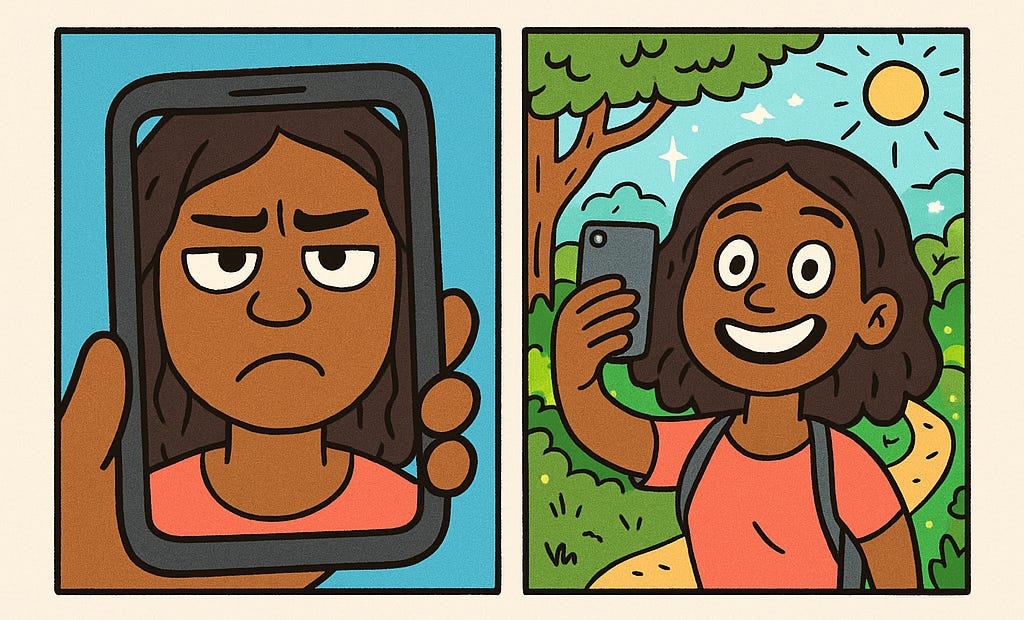
They had participants snap selfies—right before, during, and after their walks. Not posed. Not curated. Just simple, in-the-moment captures.
Then they analyzed them. Frame by frame.
And compared to the control group, what they found in the awe-walkers was stunning:
Their selfies changed. Less face, more sky. Like something in them was stepping back to let the world in.
Because that’s what awe does. It widens the lens. Shifts the focus from me to we, from “How do I look?” to “Look at that.” It reminds us we’re part of something vaster, older, more intricate than the swirl of our own thoughts.
Not by erasing you—but by connecting you to something larger.
And somehow, even in a square little frame, you could feel it.
And it wasn’t just the background. Their smile intensity increased.
Awe didn’t just shift perspective—it showed up on their faces.
And again—this wasn’t a spa retreat in Big Sur. These were city sidewalks. Neighborhoods. Parks you’d normally walk through without looking up. The only thing that changed was how they paid attention.
Let’s pause to appreciate how quietly radical that is.
Micropractice #22: Wander & Wonder—The Micropractice That Makes Sidewalks Sacred
The next time you head out—for groceries, for steps, for sanity—try this:
Silence your phone (or switch to airplane mode) if you can.
Keep your pace light—think 10 or 11 out of 20.
Not too slow, not a power walk.
Just enough to let your senses catch up.
To let your body move without urgency.
Walk like you’ve just landed on this planet.
Like every tree is a question. Every crack in the sidewalk is a doorway.
Let your gaze land where it wants to.
Let it all feel new.
Not because it is—but because you’re finally seeing it.
That leaf fluttering like it’s waving at you.
The way the light shifts.
The sound your steps make—like the ground is gently greeting you back.
The simple magic of being able to walk. Or see color. Or hear sound. Or taste the air.
This isn’t about forcing.
It’s about opening to the extraordinary tucked inside the ordinary.
You don’t need to feel amazed.
Just let yourself be available to amazement.
You’re not trying to feel anything.
You’re just tuning in to what you usually tune out.
And sometimes, the more you wander, the more you wonder.
Awe doesn’t ask you to do more.
It just asks you to see differently.
If this gave you a glimmer—or even made your shoulders drop half an inch—send it to someone who’d appreciate a moment like that, too.
Awe’s better when it echoes.
Falling for the small stuff,
Eli Susman, PhD
Founder, The Micro Memo
micropractice.com
P.S. If you want to dive deeper into the science and soul of awe, I can’t recommend Awe by Prof. Dacher Keltner enough. Dacher was one of my PhD mentors at Berkeley, and his book captures this topic with the kind of wisdom, warmth, and wonder that lingers long after you’ve put it down.
Let’s make well-being a way of being.
Your Weekly Microdose of Science-Backed Calm, Connection, and Purpose
What can you see that does NOT ordinarily inspire awe that is awesome?
David Bentley Hart, in his book, "The Experience of God: Existence Consciousness Bliss," makes a beautiful case for the fact of existence itself being the most awesome thing imaginable and it's only our taking it for granted (habituation) that keeps us from being in a constant state of awe.
Imagine, he says, walking through a beautiful forest, one you've so familiarized yourself with that you've come to take it for granted.
You come to a clear and ahead of you you see a sphere, 20 feet in diameter, hovering 3 feet off the ground, shimmering, radiating beautiful waves of multi-colored light.
Your mind would literally be stopped and you would spontaneously stand there in awe.
But if, as Blake tells us, "the doors of perception were cleansed," we would see everything as it is in truth, infinite.
And we don't have to wait years for meditative practices to kick in, or even find some psychedelics.
********************************
When you're outside, notice the sky.
Notice it has no boundaries.
Notice there are no boundaries between you and the sky and the space all around you.
Listen to sounds.
Listen to the "sound" of your inner voice, hearing the verbal thinking as meaningless sound.
Notice there is no boundary between the sounds "in" here and "out" there.
Be with the space within and space without, and feel how this unbounded, non boundaried spaciousness embraces all the forms of sensory perception; notice how the "sensory images" that make up our world are not in any way separate for the spacious awareness within which they appear.
Finally, notice how we "live and move and have our being" in this unbounded flow of constantly emerging sensory, emotional, cognitive display.
****************
The above can take less than 10 seconds once you've gotten used to it.
But music and imagery may help prepare you:
https://medium.com/@donsalmon7/two-minutes-of-bliss-d43ed8bca177
and then come back to Dr. Susman's page here, and learn more about how awesome it is that scientific research so fully supports this!!
I put a comment on your linked in page, but I thought I might follow up here.
Folks, Eli posted a short comment about 30 second micro practices. I was skimming through various sites to see what I needed to respond to later today, and it was just before I started my workout.
So i decided to see what it felt like to do a 30 minute workout as a set of 30 second micropractices. Well, first thing it turns out do to one set of repetitions well takes 1 minute rather than 30 seconds, so i adjusted it to 30 1 minute micropractcies.
Honestly, it was awesome (and I'm not just saying that because I'm here)
You do one minute and folks - if you've worked out you know what's next - you pause.
Boy I had more fun pausing today than in quite awhile. For one thing, I was tired of watching some of the "serious" videos I often watch and chose a "how to draw" video (Jan and I are practicing drawing in the evenings while watching a show or two, or listening to music).
I also just really FELT my body in between the 1 minute micro workouts.
And I was thinking how this could be so powerful for procrastinators. Like, I'm learning today how to upload a course to Udemy. If I think of that as a full day task, my response goes from "awe" to awful! Horrendous burden.
But I know I actually enjoy surfing various Udemy courses and seeing how they do it. Remembering to pause and enjoy the awesome relaxation and silence can be a whole different way of doing it.
So I'll leave it at that - and having put this out in public, am confessing to commit to this, and will report back soon to see how the Udemy micro practice day goes!!
Thanks Eli:>))))))