
The Hidden Problem With Lightbulb Moments
Why your breakthroughs often don’t break through—and why that’s good news.

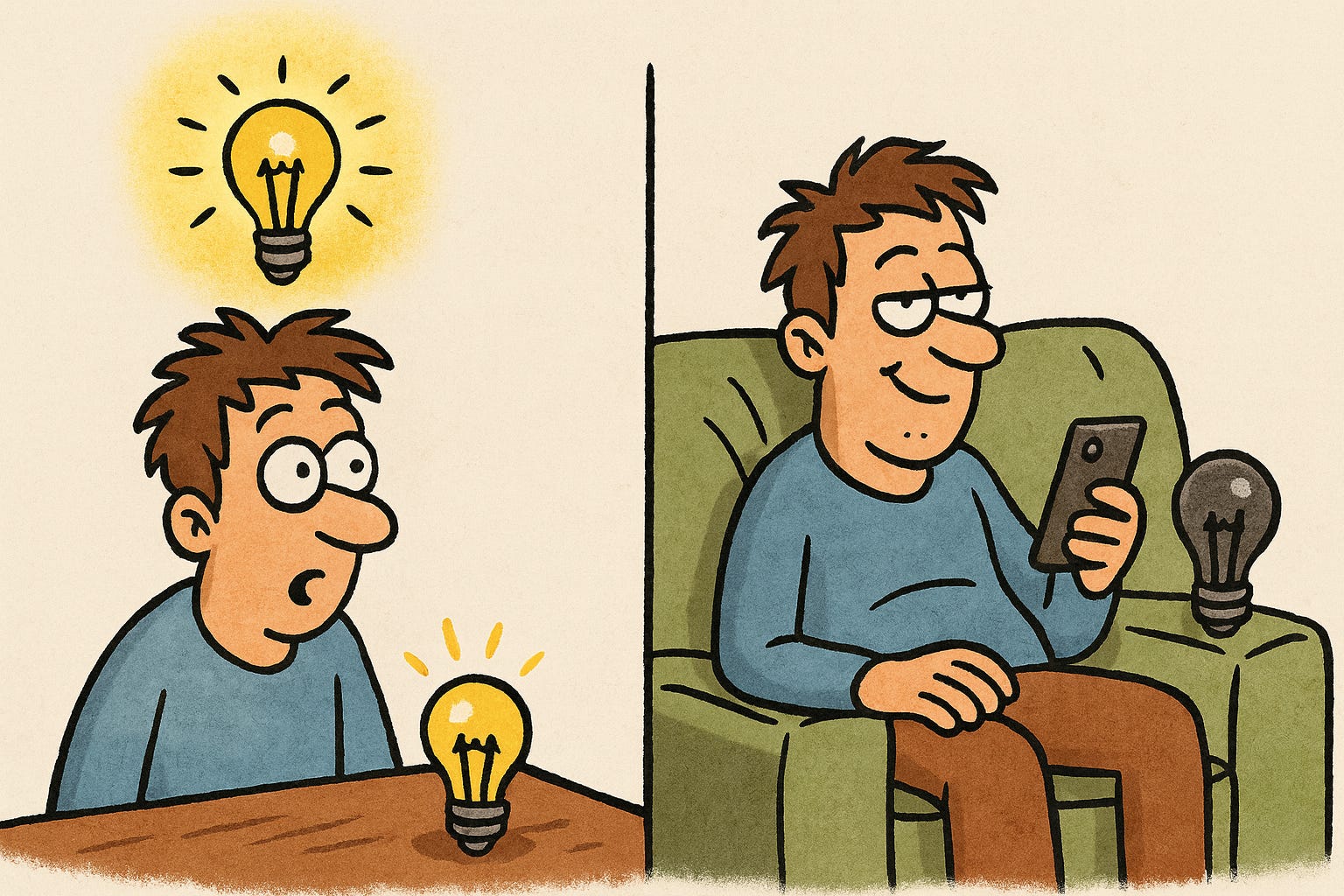
Have you ever caught yourself suddenly thinking, I should probably start meditating? Maybe it’s after a day that chewed you up and spit you out. Or while doom-scrolling and stumbling on a video of hamster doing tai chi with more inner peace than you’ve felt in a decade (hypothetically speaking). Either way, something in you pauses. Something knows.
You download the app, certain you’ll start tomorrow.
…And then three weeks later, the app is unopened, buried on page three of your home screen.
The insight was real. Life just kept happening.
But you weren’t wrong. You just weren’t done.
Why Your Brain Falls in Love With Insight (And Forgets to Use It)
A recent series of studies on digital mental health programs dug into this exact tension—the gap between insight and actual change. Researchers asked: When do people feel those lightbulb moments? And do those moments actually help?
Across 693 participants, many reported having an “Aha!” moment—defined as a sudden shift in perspective, like seeing a new truth click into place.
The top Aha! triggers? In order:
Cognitive restructuring (e.g., “Would you talk to a friend the way you talk to yourself?”)
Exposure (“Saying no to social events might feel safe now, but it deepens loneliness later.”)
Social skills (“Eye contact isn’t showing off—it’s showing up.”)
But here’s where it gets interesting:
In one of the two studies, people who had an Aha! moment showed stronger improvements in loneliness eight weeks later.
In the other study? No significant difference.
The Aha! didn’t always translate to outcomes.
At least, not on its own.
Not All Gold Glitters
Even more surprising? One of the most well-established strategies in all of psychotherapy—behavioral activation (basically, doing meaningful, rewarding things even when you really don’t feel like it)—was least likely to spark an Aha! moment. Just 2% of participants flagged it as a “lightbulb” moment.
But here’s the plot twist: that doesn’t mean it wasn’t working.
In fact, decades of research show that behavioral activation reliably reduces symptoms of depression, loneliness, and anxiety—not because it feels profound, but because it’s practiced. Repeated. Embedded. Like brushing your teeth. Or calling your friend back. Or standing up to stretch after an hour of emails, even when no part of you feels like it.
It’s not dramatic.
It’s not cinematic.
It just…works. Quietly. Incrementally. Persistently.
And here’s where the science gets even more interesting: studies show that behavioral activation is just as effective as full Cognitive Behavioral Therapy (CBT) for depression, even though CBT includes behavioral activation plus cognitive restructuring and several other tools.
And when researchers isolate the cognitive restructuring piece—the part that gets all the Aha!s—behavioral activation often outperforms that, too.
In other words, cognitive restructuring—the part of CBT that delivers all the Aha!s—wasn’t the essential driver of improvement. The quieter skill that looked the least profound carried more weight.
It’s a bit like discovering the best part of your morning coffee isn’t the inspirational quote on the mug—it’s the caffeine quietly doing its job.
Why “Again” Beats “Aha!”
Often, the most transformative practices don’t feel transformative.
They feel…ordinary.
If you’ve ever tried a micropractice—like three mindful breaths, a hand on your heart, or glancing at nature—you might’ve wondered: Does this even matter?
It can feel small. Too small.
No epiphany. No fireworks.
But repetition—not revelations—is what reliably rewires the brain.
And behavioral activation, that barely-Aha’d underdog, is all about this:
doing the thing. Not when it feels poetic, but when it’s possible.
Again.
And again.
Until your nervous system starts to believe you.
Until your life starts to shift—not because you had a breakthrough, but because you kept showing up.
That’s what makes micropractice powerful.
It doesn’t need to blow your mind.
It just needs to meet you where you are—again and again.
Insight can be magnetic. It can make us feel seen, soothed, or even heroic. And yes—people who had Aha! moments were more satisfied with the intervention.
But Aha! didn’t always lead to A-habit.
This is why micropractices matter.
Why a 30-second pause, a breath before a reply, or noticing the shape of a leaf on your walk—matters.
They might not feel like much.
They rarely earn an Aha!
But they’re not here to impress you. They’re here to rewire you.
They’re the behavioral equivalent of compound interest.
Tiny deposits. Frequent. Unflashy. Transformative over time.
That doesn’t mean insight is meaningless—far from it. A great realization can motivate, validate, or redirect.
But it’s repetition that helps it stick.
And it’s action that helps it grow.
Not all lightbulbs need to be neon.
Some just flicker on…
again and again.
Just One Brick
When something resonates—an idea, a quote, a lyric—try this:
Ask:
“What’s one small way I can live this? Today?”
Then do it. Just once. That’s your brick.
You don’t need the whole building plan. Just today’s brick.
And if you keep laying them—quietly, steadily—you’ll look up one day and realize you built something without announcing a thing.
If this gave you an insight—share it before... what were we talking about again?
May your revelations become repetitions,
Eli Susman, PhD
Founder, The Micro Memo
Micropractice.com
Make Well-Being a Way of Being
Your Weekly Microdose of Science-Backed Calm, Connection, and Purpose
One brick at a time!
Yes. I'm finding that this translates over to meditation, the simple act of sitting for a short bit and then recognizing when my mind does its 150 wandering moments (recognizing this without any judgement, just acknowledging). Afterwards, the Aha moments come and the confidence to engage socially returns, little by little, like exercising a tennis swing.