
The Difference Between Posting and Progress
Why the posts that feel productive often aren’t

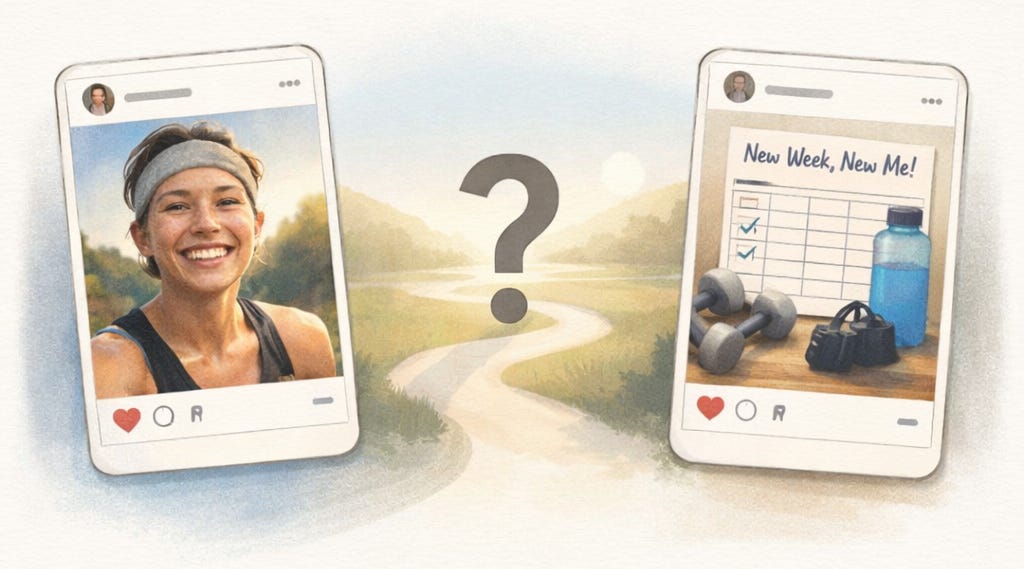
You’re out for a run, dripping with sweat, hair doing something unspeakable. You pause at a red light and think, “This would be a good time for a selfie.” Not because it’s flattering, but because you feel…real. In motion. Like you’re actually doing the thing.
You snap the photo.
Do you post it?
Now imagine the same you, same phone, but it’s Sunday night. You’re sitting on the couch, cropping a screenshot of next week’s workout schedule titled “New Week, New Me 💪”
That one’s easier to share. No sweat. No mess.
Both are “goal-related” posts. But according to new research, only one tends to lead to follow-through.
The Post That Predicts Whether You’ll Stick With It
We’ve talked about how sharing your goals, and who you share them with, can boost commitment. But it turns out the way you share them may matter too.
In a real-world Instagram study of 253 people doing a 12-week fitness program, researchers tracked different types of posts:
Goal-intention photos: plans, schedules, vision boards, motivational quotes.
Goal-pursuit photos: sweaty selfies, mid- or post-run snapshots, healthy post-workout meals.
Non-goal photos: pets, friends, family, travel, everyday life shots
Only one of these predicted whether people actually stuck with the program.
The winner? Goal-pursuit photos
Posting your progress—not your plan—was tied to significantly higher follow-through.
Intentions got likes.
Actions got results.
Why? A couple possible reasons:
You’re reinforcing a behavioral identity, not just a desired self-image. Each post isn’t a flex—it’s a footprint. A signal to yourself (and maybe to others) that this isn’t just who you wish you were. It’s who you’re becoming, one real action at a time.
And you create a record of effort—a breadcrumb trail of real steps taken. Psychologists call this self-monitoring. Just noting that you did the thing can be surprisingly motivating. It rewards the act, not just the outcome. And over time, those small rewards help turn a spark into a habit. In my upcoming book, Micropractice, I show how to use self-monitoring to build habits that stick. Not to keep score—but to keep yourself company. To stay connected to the path you’re already walking.
It’s not about showing off.
It’s about staying in motion—and letting it be seen.
By others. And by you.
Because sometimes what keeps a goal going isn’t a grand plan.
It’s the gentle pull of being seen.
So if you are going to post about your goals:
Post the process, not just the promise.
You might just show up again because of it.
Does this contradict sharing goals with others?
In an earlier Micro Memo, I wrote about the power of sharing goals in conversation—telling someone, then telling them again later—not to announce, but to keep the goal warm. That work focused on repetition over time, in low-stakes, human exchanges.
This post looks at something different: what you share publicly, and when.
Put simply:
Conversations help goals survive by inviting support.
Progress-sharing helps goals stick by reinforcing action.
And they work even better together.
You might tell a friend you’re starting a micropractice.
Then, later, mention the practice you actually did.
Not to impress. Just to keep the effort visible.
Same goal.
Different moments.
Different mechanisms.
Announce the intention if it helps.
But let progress—not promises—do most of the talking.
Let this post wander into someone else’s day.
Best-case scenario, you spark momentum. Worst-case, you reduce the global supply of vision boards.
Data point: you showed up to read this,
Eli Susman, PhD
Author of Micropractice
Founder, The Micro Memo
Micropractice.com
Make Well-Being a Way of Being
Your Weekly Microdose of Science-Backed Calm, Connection, and Purpose